The all-new 2014 Jeep® Cherokee took the Texas Truck Rodeo by
storm, forging riverbeds, conquering rocky hills, and the
competition, winning the "Compact SUV of Texas" award. In addition,
the new Jeep Cherokee was the runner up, to the 2014 Jeep Grand
Cherokee, in the coveted "SUV of Texas" in voting by the Texas Auto
Writers Association (TAWA).
The Jeep Cherokee made a big impression on the members of TAWA who
voted for the Cherokee as Compact SUV of Texas, by almost a
two-to-one margin. With solid competitors in the Compact SUV
segment, it's an impressive win for the all-new Cherokee.
The 2013 TAWA Truck Rodeo jury consisted of 41 TAWA members and the
competition featured two days of uncompromising on- and off-road
vehicle evaluation in the Texas hill country. Consideration is
given to everything from exterior styling and off-road capability
to the entrant's overall utility, value and fuel efficiency.
Not all compact SUVs could handle the off-road terrain. The 2014
Jeep Cherokee Trailhawk willingly followed the footprint of the
2014 Jeep Wrangler on both the ranch roads and the extreme off-road
course, which was limited to only truly capable vehicles.
TAWA members drove both the 2014 Jeep Cherokee Trailhawk and
Cherokee Limited models during the two-day competition at the
Knibbe ranch outside San Antonio, Texas. The 2014 Jeep Cherokee
impressed the jurors with its off-road capability as well as its
exceptional on-road manners and well-crafted interior.
Jeep Brand Vehicles reigned supreme at the 2013 Texas Truck Rodeo,
winning in every category the brand entered:
Monday, October 21, 2013
All-new 2014 Jeep® Cherokee Wins at Texas Auto Writers Association (TAWA) Truck Rodeo


Friday, October 18, 2013
Durango. Burgundy. It's Kind of a Big Deal.

We've seen it before – the well-known TV anchorman we've grown up watching on the news turns into a product pitchman. But a fictional TV news anchor? Don't act like you're not impressed. I'm talking about the partnership between the Dodge brand and Paramount Pictures – the much anticipated film 'Anchorman 2: The Legend Continues.'
If you haven't yet seen the new spots, you are in for a treat. If you haven't seen them all, you'll be in for a laugh for some time to come. There are 70 different spots featuring Will Ferrell as Ron Burgundy, starring as the pitchman of the new 2014 Dodge Durango.
During today's ad briefing, Chief Marketing Officer of Chrysler Group LLC Olivier Francois explained that it's a "unique way to showcase the cutting-edge technology of the Dodge Durango in a completely unexpected approach that is fresh, funny and culturally provocative."
The humor lies in the fact that Ferrell delivers the pitch in the character of Ron Burgundy, an arrogant anchorman straight out of the 1970s, which means he has a bit of a different take on the many features of the Dodge Durango.
In one spot, Burgundy completely ignores the advanced technology of the 2014 Dodge Durango and instead concentrates on what fits nicely in the glove box.
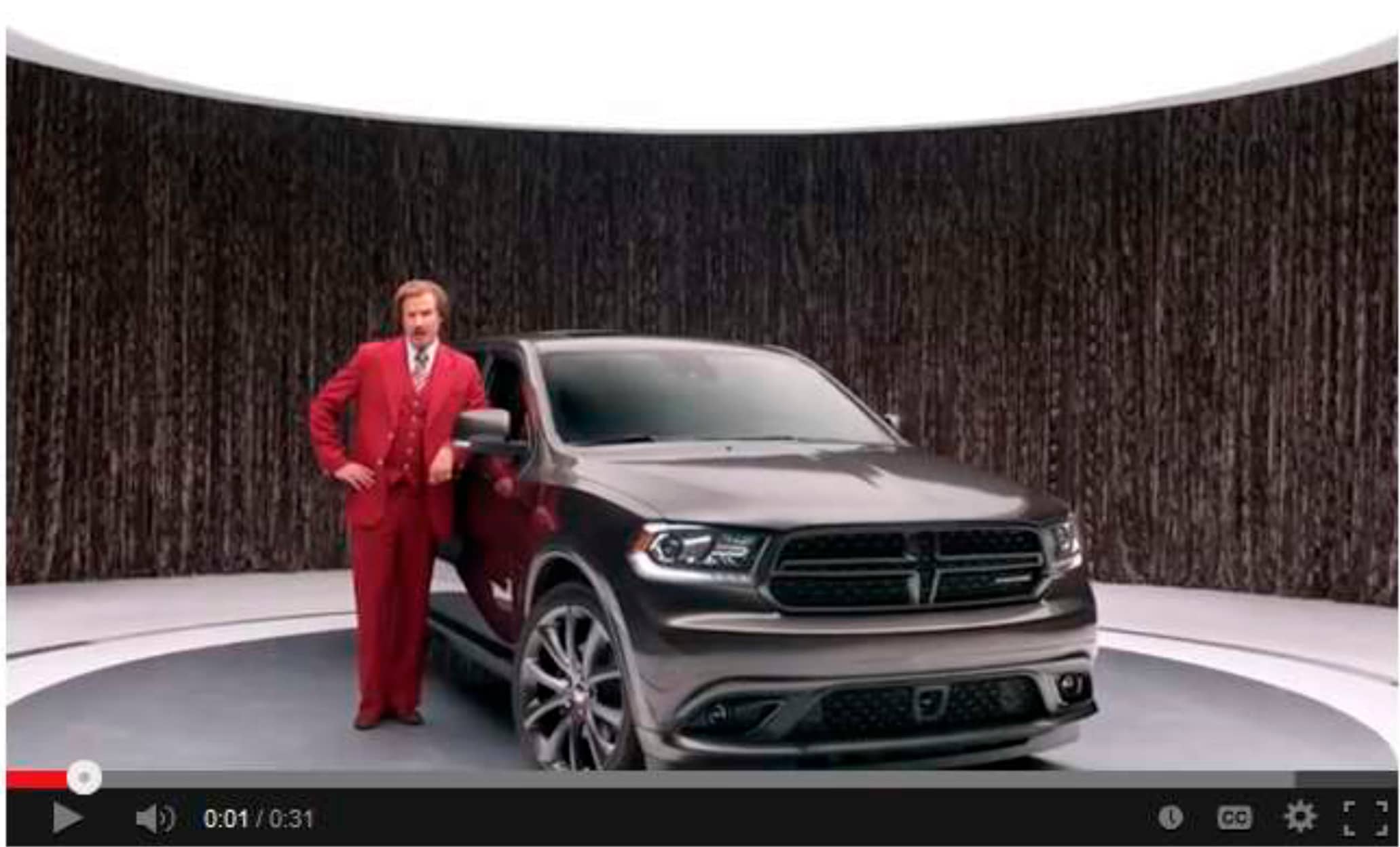
In another spot, see him discuss the Dodge Durango's 360 horsepower with a single horse:

That's just two of the commercials. What's next? More of the 70 spots will roll out in the coming weeks. All of them can be viewed on the BurgundyDodge.com. They won't all roll out at once, so check back often. The spots will help build anticipation for "Anchorman 2: The Legend Continues." You can also follow our Facebook page to see other video content. (Also, when you "Like" our Facebook page this month we are donating a $1.00 for each new "Like" to Breast Cancer in support of Breast Cancer Awareness Month!)
Seventy spots may sound like a lot, but with a talented actor and comedian behind the wheel, the ads rolled off Ferrell's tongue totally unscripted and ad-libbed. That's a lot of content and a lot of humor.
The spots will air through the end of the year. The movie arrives in theaters Dec. 20. The 2014 Dodge Durango is in showrooms now.
When it comes to a unique and effective advertising campaign, you have to admit, it's kind of a big deal.
Thursday, October 17, 2013
2014 Jeep Cherokee
Let's not mince words: the 2014 Jeep Cherokee is a weird-looking little crossover. However, after taking a spin behind the wheel of a Cherokee Limited and then a Cherokee Trailhawk and then giving the little SUV a scrutinizing walk-around, I'm happy to report that not only does it look better in person than it does in photos, but it also delivers performance and tech that exceeded my admittedly moderate expectations.
Two engine options
Two engine choices are available for the 2014 Cherokee, the first and standard option being Chrysler's 2.4L Tigershark MultiAir four-cylinder engine. This is the same mill that you can find under the hood of the 2013 Dodge Dart GT, should you be inclined to look, and is good for 184 horsepower and 171 pound-feet of torque while returning 22 city mpg and 31 highway mpg over the EPA's test cycle. That's an adequate amount of power. Though my three passengers and I weren't exactly blown away by the crossover's acceleration, the Jeep wasn't left wanting or wheezing during my short drive through the hills of San Francisco's Presidio. For drivers who prefer to take it easy, this is the configuration to choose.
Drivers who want a bit more power also have the choice to option a 3.2L Pentastar V-6 engine. This is actually a downsized version of the Chrysler Group's 3.6-liter Pentastar V-6 that has served the brand for years. At this displacement, it outputs 271 horsepower and 239 pound-feet of torque. Dropping a few ccs of displacement has allowed the Pentastar-equipped Cherokee to reach an estimated 19 city and 27 highway mpg on the EPA's test cycle.
In this configuration, the Cherokee is much more responsive to throttle inputs with, obviously, much better acceleration when asked. I'll gladly take the 3-mpg highway hit for the additional get-up-and-go and the additional towing capability that the torque-ier V-6 affords.
Either engine is mated to a nine-speed automatic transmission that features sport and manual shifting programs. Having nine forward speeds means that the Jeep does a lot of shifting when tooling around town, but you get used to the smooth gear transitions.
Four drivetrain options
At the lower trim levels, the Cherokee can be had with front-wheel drive, but the models present during my testing were both 4x4 models. Jeep actually offers three different versions of its Active Drive all-wheel-drive system.
Active Drive I is the simplest setup, which uses brake-based traction control to optimize its grip for different terrain types. It also features a rear-axle disconnect, which allows the system to free-wheel its rear wheel under most conditions -- effectively giving it the efficiency of a front-wheel-drive system -- then instantly re-engage rear drive when front-wheel slip is detected.
Active Drive II builds on the first system with the addition of a low-range drive ratio and a neutral mode that totally disengages all four wheels for flat towing.
Finally, there's the Active Drive Lock system, which is standard on the Trailhawk. This system also features a 4-Low drive ratio for high torque at low speed when, for example, rock crawling. Also added to the mix at this level is a rear locker, which can lock the rear wheels, which usually spin independently, into a fixed axle, increasing grip for off-road activities.
The Active Drive system features optimizations for a variety of surfaces, which the system can automatically detect or the user can specify using the Selec-Terrain traction controller knob on the center console. There are settings for auto, snow, and sand and mud. There's also a sport setting that optimizes vehicle performance and the transmission's program for more responsive on-road driving. For Active Drive Lock models, there's also a setting for rocks and it has buttons that engage the 4-Low drive ratio, rear locker, and descent speed control.
The Trailhawk trim level also features a number of other off-road optimizations to go along with its Active Drive Lock system. The suspension has been raised an inch over the stock ride height to increase its break-over angle and water-fording depth (now up to 20 inches). The front and rear bumpers are unique, increasing its approach and departure angles. Bright-red tow hooks have been affixed to the chassis at the front and rear ends and skid plates have been affixed to the undercarriage to protect the suspension from branches and rocks.
I wasn't able to really test Jeep's claims about the Cherokee Trailhawk's off-road chops, but was assured that the crossover had earned its Trail Rated badge during testing in the Mojave and on the Rubicon trail.
Our testing took place on public roads, so it should come as no surprise that I preferred my drive in the Limited model. Without the off-road optimizations, the standard suspension setup gave the crossover a much better seat-of-the-pants feel with much more responsive steering and a firmer ride. That the Limited was equipped with the larger engine option helped.
Uconnect dashboard tech
The 2014 Cherokee is available at all trim levels with the Chrysler Group's Uconnect infotainment system. We've seen this system before in a variety of Dodge, Chrysler, and Jeep vehicles and really like it.
The giant 8.4-inch touch screen is easy to see and gives plenty of room for large virtual buttons that can be quickly tapped from the driver's seat. Navigation with traffic is available, optional, and powered by Garmin's excellent mapping and routing software. And the list of available digital-audio sources is satisfying in its inclusiveness. Whether you connect via Bluetooth, USB, or aux-in, or carry your music around on an SD card, you'll find the connection that you're looking for in the Cherokee's dashboard.
I also like the connectivity and telematics features that have been added to this latest generation of Uconnect Access, which includes app integration with Yelp, Pandora, Slacker, Aha Radio, and others, as well as an optional WiFi Hotspot functionality that allows passengers to connect to the Web via the Cherokee's 3G data connection.
Around the cabin you'll also find a variety of standard and optional convenience features such as a powered lift gate, a wireless charging pad for smartphones, and an optional dual-pane sunroof. Non-tech features such as a reclining rear bench and a hidden storage bin in the front passenger seat cushion are also nice touches.
Safety technology and automatic parking
Getting off the beaten path is cool, but most Jeep Cherokees will probably live most of their lives on public roads, in traffic with other drivers. So Jeep has made available an impressive array of safety and convenience features for a vehicle in this class.
In addition to the rear camera, the Cherokee can be had with front and rear proximity sensors with ParkSense braking assistance, which can grab the brakes automatically if, for example, a dog or toddler darts behind the vehicle while it's reversing. Also available are blind-spot monitoring with cross-traffic alert and an optional lane departure warning system that can notify an inattentive driver when that the vehicle is drifting out of its lane.
Optional adaptive cruise control boasts a feature called Stop and Go, which can bring the vehicle all the way down to a complete stop when traffic slows down and then resume forward motion as traffic creeps ahead. The forward sensor for the adaptive cruise also feeds a forward collision warning system that can notify the driver when a crash is imminent and automatically apply the brakes.
Finally, the Cherokee can be had with Active ParkSense, which is an automatic parking system similar to the one that Ford offers for many of its latest vehicles. This sonar-based system is a one-button affair that can automatically search for available roadside parking on the passenger side of the vehicle, notify the driver when a sufficiently sized space has been found, and then automatically steer the Cherokee into the space. This is the first implementation of this technology for the Chrysler group and one of the first vehicles that I've tested that offers the driver the choice between parallel parking and perpendicular parking.
In sum
You may not be a fan of the Cherokee's looks, but there's a lot to like beneath the sheet metal and in the cabin. The 4x4 drive train mated with the optional 3.2-liter engine makes for engaging, yet still relatively efficient performance. Meanwhile the level of available safety and convenience tech is impressive. The Cherokee's cabin is crammed with sophisticated features that I think would make this crossover easy to live with on a day-to-day basis, whether tackling dirt trails or urban canyons.
As read on: http://reviews.cnet.com/suv/2014-jeep-cherokee/4505-10868_7-35828240.html#!
Wednesday, October 16, 2013
An Early American, Ready to Try Again
On Sept. 17, 2003, an all-new model from the Indian Motorcycle Company of America was delivered to me for a review.
Two days later, the Gilroy, Calif., company locked its doors and went out of business. Its disappearance was so sudden and so complete that I had no idea where to return the motorcycle.
The comings and goings of would-be makers of motorcycles carrying the Indian brand name have for years been a steady source of work for reporters. But this was the first time that I recall having to write a birth announcement and a death notice in the same week.
A list of the various entities that have claimed ownership of the Indian name, trademarks or motorcycle brand would be long indeed. The original Indian motorcycles came from Springfield, Mass., in 1901 — two years ahead of Harley-Davidson’s arrival — and lasted until 1953, along the way establishing a strong reputation on racetracks.
Since then, at least a dozen purveyors have used the brand name and logo, some legitimate, some clearly not. In fact, in 1998, the Gilroy-based company had to consolidate rights from nine claimants before it could begin the process of creating its own short-lived version.
So it was with a measure of wariness — even suspicion — that the news was received in 2011 that Polaris Industries, known for its snowmobiles and watercraft, would be the latest to acquire the rights to Indian.
But it’s worth noting that Polaris also is the parent company of the well-regarded Victory Motorcycles, which it established 15 years ago. So Indian’s newest owners at least were experienced and competent in the art of making motorcycles.
Polaris, a company with $3 billion in sales based in Medina, Minn., also offered the Indian name something it had lacked for decades — the deep pockets required to build no-compromises bikes.
In the two years since its purchase, Polaris has invested tens of millions of dollars, expanding the research and development department, production capabilities and other infrastructure it determined were needed to give Indian a fitting revival.
At the huge Sturgis, S.D., motorcycle rally in August, the company unveiled a new lineup of heavyweight cycles bearing the Indian logo: the Chief Classic ($19,399 including shipping), Chief Vintage ($21,399) and Chieftain ($23,399).
The 111-cubic-inch (1.8 liters, if you prefer) Thunder Stroke V-twin engine that powers all three is billed as Indian’s first all-new power plant in 70 years.
“People questioned whether we were just going to slap an Indian logo on a Victory motorcycle and call it ‘mission accomplished,’ ” Steve Menneto, vice president for motorcycles at Polaris, said in an interview before the introduction.
“Our new Indians are just that: new, all new,” he said. “They share less than 1 percent of content with Victory.”
Although the Indian models are built in shared facilities with Victory in Spirit Lake, Iowa, Mr. Menneto said the personnel, equipment and production lines were all separate.
The power source for the Indian line is a fuel-injected 49-degree V-Twin that produces 119 pound-feet of torque. It hews to tradition with air cooling, and considerable effort was devoted to preserving nostalgic styling cues like the angled cooling fins on the cylinder heads and the positioning of the exhaust pipes. Before its introduction, Mr. Menneto said, the engine had been subjected to the equivalent of more than two million development miles.
Engineers also lavished considerable attention on the sound it would make — a key consideration for a motorcycle that is aimed directly at the Harley constituency.
Indeed, the engine roars to life with a deep, satisfying-but-not-deafening report. Hammer on the throttle and the resulting bam-bam-bam is almost like that of an old fighter plane. Well played.
The Thunder Stroke 111 is meant to trump Harley-Davidson’s largest offerings in every way. Lacking a scientific side-by-side comparison, I can only say that from a subjective standpoint, it’s game over.
The engine feels particularly well-sorted, even when subjected to the harshest environments. I rode 400 miles from Southern California to Utah recently, with only two brief stops for fuel; the trip lasted six hours and averaged 70 m.p.h. up and down several mountain ranges, up to 10,420 feet in elevation in Utah, through 107-degree temperatures in Baker, Calif., and even in some stop-and-go traffic around Las Vegas.
Yes, the heat roiling off the engine then was duly noted. But there was nary a hesitation from the Thunder Stroke 111. The power at all speeds was instant and gratifying.
Gary Gray, Indian’s product director, had told me before the trip that I could expect to average “low to mid-40s” in my fuel economy.
That sounded optimistic, as I typically see mileage from the high 20s to mid-30s in long-distance tests of heavyweights from Harley, Honda and Moto Guzzi. But I averaged a commendable 42 m.p.g. for my Indian romp.
The bike was also all-day comfortable, in seating and riding position, implacably stable and easy to ride. It did not feel the least bit tippy or cumbersome at slow speeds, as some heavyweights do. The brakes provided good stopping power, and I liked that the antilock system did not link front and rear brakes.
The new Indians are easy on the eye, too. The Chief and the Vintage are such singular Indian classics that they almost designed themselves, Mr. Menneto said. “They each have five or six iconic styling cues, and we brought those forward and added modern-day tech.”
Along with the valanced fenders, teardrop fuel tank, leather saddle and lighted mascot on the front fender, the base bike, the Chief Classic, has a 6-speed transmission, air-adjustable single-shock rear suspension, cruise control, belt drive, antilock brakes and keyless starting with central remote locking.
A step up to the Vintage adds fringed tan leather quick-release saddlebags, a matching leather two-place seat, additional chrome trim and a quick-release windshield.
The most intriguing offering is the top-line Chieftain. It is the first bagger — a model with hard saddlebags and front fairing — that has ever worn the Indian badge.
“The Chief and the Vintage are quintessential Indians,” Mr. Gray said. “With the Chieftain, we weren’t as restricted in what we could do from a styling standpoint. The fork-mounted fairing is shaped with a streamlined 1930s locomotive in mind.”
The Chieftain also is equipped with an audio system (including fairing-mounted speakers), 12-volt power plug, Bluetooth capability, tire pressure sensors and motorized windshield adjustment.
“The bagger segment is one of the largest in the industry, and we knew that is one of the arenas we had to play in,” Mr. Menneto said.
Reminded that Victory has a similar offering in the Vision, Mr. Menneto said internal research indicated there was little chance of one brand cannibalizing sales of the other.
Still, during one of my brief stops on the test ride, a Vision owner pulled up to admire the Chieftain.
“I love my bike,” the rider told me. “I won’t trade it for anything. Except maybe that.”
As read on: http://www.nytimes.com/2013/10/13/automobiles/autoreviews/an-early-american-ready-to-try-again.html?pagewanted=1&_r=0&adxnnl=1&adxnnlx=1381858096-RAgWve6HAWR7huSbUEhXGw
Tuesday, October 15, 2013
What's New for 2014 Durango
What's New for 2014
The 2014 Dodge Durango gets a new eight-speed automatic transmission, revised front and rear styling, and an updated interior with newly available features like an 8.4-inch touchscreen display and a rear-seat Blu-ray player. Trim levels and equipment have also been shuffled.
Introduction
The Dodge Durango is one of our favorite options for a six- or seven-passenger SUV. The current generation not only has the roomy seating and polished ride that you'd expect in a family-oriented, three-row utility vehicle, it also has an optional V8 engine and impressive tow ratings that you typically see only on larger, more traditional SUVs. For 2014, Dodge (http://www.edmunds.com/dodge/) has updated the Durango to help it keep up with the competition in this price range. Although the even more aggressive styling is what you'll notice first, it's the less obvious changes that make the biggest difference on the 2014 Dodge Durango.
The changes in the cabin are particularly striking, as the Durango gets an all-new instrument panel and an updated dash that accommodates a large, intuitive 8.4-inch touchscreen that uses an upgraded version of the company's Uconnect system to provide smartphone app integration, text-to-speech capability for text messages and a more robust voice control interface. High-quality interior surfaces abound, and much like its Jeep Grand Cherokee cousin, the 2014 Durango feels decidedly upscale for its class.
On the mechanical side, the 2014 Durango has a new eight-speed automatic transmission, which serves up impressively smooth shifts while providing a numerically small but still significant improvement in EPA fuel economy ratings. The new transmission also makes better use of what power the base V6 engine has to offer -- although we've steered consumers toward the more powerful V8 in past years, a V6 Durango merits stronger consideration in 2014 due to its more energetic performance.
Of course, we'd still recommend the V8 if you intend to take frequent advantage of the 2014 Dodge Durango's towing capability, which, along with its rich interior and unusually good ride and handling, is one of the best reasons to consider this SUV. However, the Durango doesn't provide as much cargo room as most of its rivals. Well-regarded family crossovers like the Chevrolet Traverse and Mazda CX-9 offer considerably more capacity. We'd also recommend that you check out the Ford Explorer and Flex. But overall the updated 2014 Durango is one of the most appealing options out there for a six- or seven-passenger SUV.
Body Styles, Trim Levels, and Options
The 2014 Dodge Durango large crossover SUV is available in four trim levels: SXT, Limited, R/T and Citadel. You'll also come across Durangos with Rallye badging; the Rallye is an equipment package on the SXT. Seven-passenger seating is standard across the board; optional second-row captain's chairs reduce capacity to six.
Standard equipment on the SXT includes 18-inch alloy wheels, automatic headlights, foglights, roof rails, heated sideview mirrors, full power accessories, cruise control, tri-zone automatic climate control (includes separate rear air-conditioning), a tilt-and-telescoping steering wheel, cloth upholstery, a fold-flat front passenger seat, a 60/40-split-folding and reclining second-row seat, a 50/50-split-folding third-row seat, Bluetooth phone and audio connectivity, and a six-speaker sound system with a 5-inch touchscreen display, satellite radio, and USB and auxiliary inputs.
Several option packages are available on the Durango SXT. The 23B package adds roof-rail crossbars, upgraded cloth upholstery, an eight-way power driver seat with four-way lumbar, a leather-wrapped steering wheel and satellite radio. The Popular Equipment Group adds heated front seats, a heated steering wheel, a rearview camera, rear parking sensors and an auto-dimming rearview mirror. The Rallye package adds 20-inch wheels, polished exhaust tips and additional body-color exterior trim while deleting the roof rails.
The Limited has most of the above equipment as standard but reverts to 18-inch wheels. It also comes with a remote ignition, leather upholstery, driver memory settings, a six-way power passenger seat, a 115-volt power outlet and an 8.4-inch touchscreen display with an upgraded version of Dodge's Uconnect system. The latter includes voice control, text-to-speech messaging capability, emergency roadside assistance, streaming Internet radio (delayed availability) and 3G Wi-Fi capability (via an extra-cost contract). The larger touchscreen and related infotainment features are optional on the SXT.
The R/T essentially includes the upgrades of the Limited (minus the roof rails) along with a V8 engine, 20-inch alloy wheels, a sport-tuned suspension, xenon headlights (low beams only), body-color accents (similar to the Rallye), a power liftgate and an upgraded nine-speaker sound system.
The Citadel reverts to a less aggressive suspension tune and a standard V6 engine, but otherwise builds on the R/T's equipment list, adding automatic high-beam control, automatic wipers, a sunroof, a power tilt-and-telescoping steering wheel, an eight-way power front-passenger seat, ventilated front seats, heated rear seats, and a navigation system with traffic updates and a Yelp-based search engine. All these amenities are optional on the R/T.
Optional on both the R/T and Citadel is the Technology Group, which includes adaptive cruise control, a forward collision warning/mitigation system and a blind-spot warning system with rear cross-traffic alerts. Also available on these trims is a rear-seat Blu-ray/DVD entertainment system with dual video screens and an HDMI input. Options for the whole lineup include a towing package, a skid-plate package (except R/T) and an in-dash CD player.
Powertrains and Performance
The 2014 Dodge Durango is offered with either a V6 or V8 engine. While the SXT only comes with the V6 and the R/T only comes with the V8, the Limited and Citadel trims can be equipped with either one. Depending on the model, rear-wheel drive, all-wheel drive or four-wheel drive is available. The light-duty AWD system is only available with the V6 engine. The on-demand 4WD system features dual-range gearing (which makes it more capable on rugged terrain) and is standard with the V8 engine. All models come with an eight-speed automatic transmission.
The 3.6-liter V6 engine is rated at 290 horsepower (295 hp with the Rallye package) and 260 pound-feet of torque. The EPA's estimated fuel economy is 20 mpg combined (18 mpg city/25 mpg highway) with rear-wheel drive and 19 mpg combined (17 city/24 highway) with all-wheel drive.
The 5.7-liter V8 is good for 360 hp and 390 lb-ft of torque. Rear-drive models are rated at 17 mpg combined (14 city/23 highway), while AWD versions are rated at 16 combined (14 city/22 highway).
Properly equipped, a V8 Durango can tow up to 7,400 pounds, while the V6 version tops out at 6,200 pounds -- in either case, far more than most rival crossover SUVs can tow.
Safety
Antilock disc brakes, stability and traction control, trailer sway control, front side airbags and full-length side curtain airbags are standard on every 2014 Dodge Durango. A rearview camera and parking sensors are optional on the SXT and standard on all other Durangos.
Models with Uconnect Access (included with the 8.4-inch touchscreen) have an emergency telematics system that connects you with 911 operators at the touch of a button and provides stolen vehicle tracking. Optional on the Limited, Citadel and R/T is a blind-spot monitoring system with cross-traffic alerts. Note that the available Technology Group available on R/T and Citadel models now includes a more advanced forward collision warning and mitigation system that automatically applies the brakes in potential collision situations.
In government tests, the Durango received five out of five stars for side-impact protection. In Insurance Institute for Highway Safety tests, the Durango earned a "Good" rating for its performance in moderate-overlap frontal-offset, side-impact and roof strength crash tests.
Interior Design and Special Features
Modern and functional, the 2014 Dodge Durango's cabin has been designed with families in mind. Regardless of trim level, the design is attractive and features upscale materials.
With this latest update to the Durango, materials quality is now class-leading, and the cabin has an uncommonly elegant feel for this class. The available 8.4-inch touchscreen display is attractive and easy to use. The gauges look better, too, with crisp graphics and a useful trip computer display.
The front seats are roomy and comfortable, but the standard second-row bench has rather flat cushioning (which helps promote a flatter load floor when the seat is folded) and doesn't offer quite as much legroom as roomier rivals. The Durango's easily accessed third row, on the other hand, offers a surprising amount of leg- and headroom (even for 6-footers) and is indeed more spacious than the Ford Explorer's.
With the second- and third-row seats folded down, the Durango can carry up to 84.5 cubic feet of cargo. This is a respectable amount, but competing large crossover SUVs like the Chevy Traverse and Mazda CX-9 offer considerably more cargo space.
Driving Impressions
The 2014 Dodge Durango is distantly related to the Mercedes-Benz M-Class, and it shows in the way this nearly 5,000-pound vehicle drives down the road. Steering is responsive and the Durango is easy to maneuver on almost any road. On a long interstate cruise, it provides a quiet and relaxed cabin environment.
Low-end torque is not a strong suit of the V6, but once the Dodge Durango is moving, the engine pulls respectably. Midrange acceleration is adequate for passing and merging, and there's a noticeable improvement in responsiveness with the new eight-speed automatic transmission. As expected, the V8 offers brisk all-around performance and a satisfyingly deep exhaust note on acceleration.
As read on: http://www.edmunds.com/dodge/durango/2014/?sub=suv


